I think the camera (an Olympus C-4000Z) must have taken a bump while the lens tube was extended because now it won’t retract or extend anymore. I can hear the motor whirring like it’s trying to move the lens into position, but it’s not doing anything.
Crap.
This is not good. What am I going to do without a camera??!!
I suppose I could try to take it apart and try to fix it. On the other hand, this would be a good opportunity to upgrade to a new camera, although I’d still be without one until I could save up enough $. Or I could go the safe (and probably expensive) route of sending it in for repair. The inner geek in me wants to do the first and second options. The rest of me wants to send it in. I suppose it’s a good thing for the camera that I don’t have a set of screwdrivers small enough to take the camera apart. At least not yet anyway…
Had Simba entered in the Sporting Group but didn’t quite make the cut. He did make me proud by being good enough to pass the CGC test though!
There was a pretty good turnout for the dog show this year with all kinds of different dogs. The dogs had a good time checking things out and despite my best efforts, nabbing bits of popcorn off the ground.
The sporting group was the second group to go, so after we were finished with that, we hit the farmer’s market for a little bit of breakfast and to ogle the strawberries
I couldn’t make it out of the market without grabbing a couple baskets of these yummy berries.
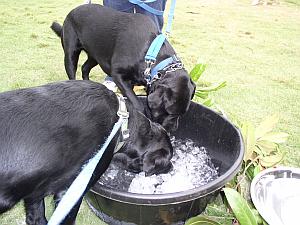
A bucket of ice water was set out so the dogs could get a cool drink as the day got warmer, so Nala couldn’t resist bobbing for ice cubes
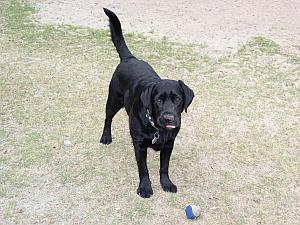
And then the morning was wrapped up with a romp at the dog park
Physics Corner was a series of articles I wrote for an incarnation of the department newsletter between 2000 – 2001. They’re collected here for posterity and maybe to provoke me into starting it up again as an online column.
When it comes to measuring and counting radiation, there are more ways to measure radiation than you can count on your fingers. And to top it all off, there are the traditional Imperial units, and the more modern SI units to confuse things even more. In this month’s column, I’ll attempt to demystify the world of radiation units.
When you boil it all down, there are essentially two types of units used for quantifying radiation. There are physical quantities used to measure the amount of radiation or energy deposited, such as the roentgen or curie (for radioactive materials), and there are units to measure the biological effect of radiation (such as the rem). The table below summarizes the different types of units used.
Ionizing radiation produces charge pairs (electron and ionized atom) when it interacts in matter, so naturally this is the first thing we look at. Plus, it’s also very easy to measure. The roentgen represents the amount of charge produced per unit mass of air and is the unit most commonly seen. In SI units, the unit of exposure is simply coulombs/kg (C/kg), which is sometimes referred to as X. The roentgen or C/kg represents a considerable amount of radiation. Exposures in the diagnostic radiology realm are generally measured in milli-roentgens (mR), or 1/1000th of a roentgen. For a little bit of perspective, the exposure to a patient receiving a chest X-ray at MUSC is typically 10-12 mR.
While knowing the exposure can be useful (in a “more is usually bad” kind of context), it doesn’t really mean much when it comes to predicting biological effects of radiation exposure which is generally what most people are interested in. In order to assess biological effects of radiation, first we need to know how much energy is deposited in matter. This is generally referred to as the absorbed dose. In the old system, the unit for absorbed dose is the rad (radiation absorbed dose), while the gray (Gy) is used in the SI system. Both units measure the amount of energy in joules (J) deposited by radiation in a unit mass of material (J/kg). For most diagnostic x-ray procedures, the absorbed dose is generally measured in the milli-gray or milli-rad region.
When it comes to radiation risk and protection, a couple more units were introduced because different types of radiation have different effects. In the old system, the unit is the rem (radiation equivalent man) and the sievert (Sv) in the SI system. As with the rad and the gray, 1 Sv = 100 rem. Both the rem and sievert unfortunately have units of energy per unit mass, just like the rad and gray. However, the rem and sievert are related to the rad and gray by a numerical scaling factor known as RBE (relative biological effectiveness). RBE relates the effect of a particular type and amount of radiation to a reference amount of x-ray radiation. X-rays and gamma rays are assigned an RBE of 1, while alpha particles are given an RBE of 20. So, while an exposure of alpha particles might deposit say 1 rad of energy within an organ, the actual effect on the organ would be the same as that produced by 20 times as much x-ray radiation.
All of this might look and sound rather messy but in the world of diagnostic radiology where the conversion factor from roentgens to rads is close to 1 and x-rays have an RBE of 1, things are a little simpler: 1 R ~ 1 rad = 1 rem.
For radioactive materials, the amounts of radioactivity present are measured in curies (Ci, old unit) or becquerels (Bq, SI unit). Traditionally, the curie was defined as the amount of radioactivity contained in 1 gram of radium-222. Now, the curie is defined as 3.7×10¹⁰ disintegrations per second. The becquerel is defined to be 1 disintegration/sec, so that 1 Ci = 3.7×10¹⁰ Bq. The curie represents a tremendous amount of radioactivity, and is definitely not something to be carrying around in your front pocket. In nuclear medicine departments, the amounts of radioactivity used are generally measured in milli-curies (mCi) or micro-curies (μCi) (mega-becquerels (MBq) and kilo-becquerels (kBq) respectively).
I’m still digesting the data from awstats, but for some reason web server stats on the server has been skyrocketing (double over the previous month) ever since the new server came online.
Radinfo was serving up 50-100 MB/day (and about the same added on for bot traffic), but since the new server came online last month, anywhere from 120-300 MB/day has been the norm now, averaging 240 MB/day. So far this month the server’s been averaging almost 270 MB/day! At that rate, I’m looking at a little over 8 GB for this month alone. With bot traffic using up about the same amount of bandwidth, that’s a total of 16 GB/month!
I’m not sure why traffic has spiked like this. Awstats doesn’t really break it down that much in terms of who is accessing what although there’s still a lot of data there to digest. Might have to stuff the web server logs into a database and do some of my own data mining to figure out what’s going on.
What the heck is going on and what the heck are all these people doing here?