Mars claims another one

Looks like Mars may have may have claimed yet another probe. After 9 years in operation in Mars orbit, the Mars Global Surveyor has gone silent.

From the NewScientest blurb:

An unexpected break in communications has NASA struggling to restore contact with its Mars Global Surveyor (MGS) spacecraft. If communication cannot be restored soon, NASA may try to diagnose the problem by having another spacecraft, the Mars Reconnaissance Orbiter, take pictures of MGS.

If no signal is heard on either day, NASA may call on the Mars Reconnaissance Orbiter (MRO) to take pictures of MGS early next week. The two spacecraft pass within about 100 kilometres of each other several times each week.
MRO’s camera is easily powerful enough to determine the orientation of the spacecraft and its solar arrays. This would reveal whether the spacecraft has gone into safe mode or not.

Considering MGS is in it’s 4th mission extension, it’s lasted remarkably well. Hope the NASA eggheads can manage to figure out the problem and recover the orbiter.
Journal Club: The 2006 Henry N Wagner Lecture

Today’s journal club article isn’t really an actual research paper, but more of a ‘where are we now and where are we going’ type of article written by a prominent nuclear medicine physicist, Simon Cherry. It comes from the November issue of The Journal of Nuclear Medicine. The article is The 2006 Henry N. Wagner Lecture: Of Mice and Men (and Positrons)—Advances in PET Imaging Technology (J Nucl Med 2006 47: 1735-1745)

By far the most interesting part of Cherry’s article is where he looks forward to the future of PET imaging and raises the idea of PET/MRI imaging and whole-body PET/MRI imaging.. Rather than using conventional photomultiplier tubes, which would be rendered useless by the magnetic field from the MRI unit, the scintillation light would be detected by avalanche photodiodes. Very tantalizing possibilities indeed.

Abstract:

There have been major advances in PET technology that cumulatively have helped improve image quality, increased the range of applications for PET, and contributed to the more widespread use of PET. Examples of these technologic advances include whole-body imaging, 3-dimensional imaging, new scintillator materials, iterative reconstruction algorithms, combined PET/CT, and preclinical PET. New advances on the immediate horizon include the reintroduction of time-of-flight PET, which takes advantage of the favorable timing properties of newer scintillators; the integration of PET and MRI scanners into a dual-modality imaging system; and the possibility of further significant improvements in spatial resolution in preclinical PET systems. Sensitivity remains a limiting factor in many PET studies. Although, conceptually, huge gains in sensitivity are still possible, realizing these gains is thwarted largely by economic rather than scientific concerns. Predicting the future is fraught with difficulty; nonetheless, it is apparent that ample opportunities remain for new development and innovation in PET technology that will be driven by the demands of molecular medicine, notably sensitive and specific molecular diagnostic tools and the ability to quantitatively monitor therapeutic entities that include small molecules, peptides, antibodies, nanoparticles, DNA/RNA, and cells.

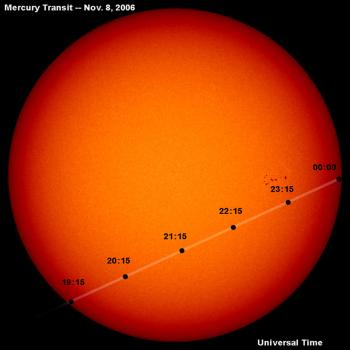
Mercury Transit

Later on this afternoon with a properly configured telescope configuration, you’ll be able to catch Mercury’s transit across the sun. If you don’t have access to a properly configured telescope, you can catch the action live from SOHO‘s point of view. The transit is supposed to start at 1912UTC, or 1412EST (2:12 PM). Mercury’s only going to do this 14 times this century, and this is the second one so far.

Transit of Mercury across the Sun

111 years of x-rays

111 years ago today, a physicist by the name of Wilhelm Röntgen caught a glimmer of light coming from a fluorescent screen located across the room from his cathode ray tube setup. The strange phenomenon caught his interest and he spent several weeks investigating the matter.

Röntgen had just “discovered” x-rays. A month later he created the first radiograph (röntgenograms as they were called back then), an x-ray image of his wife’s hand. The new rays were a huge hit among physicists, enabling the discovery of all kinds of wonderful things about the properties of matter. Once word reached the medical community of this new discovery, it wasn’t long before Röntgen’s new rays were used to image and treat patients.

The first x-rays were used to treat a breast cancer patient a mere two months after Röntgen’s discovery. Shortly after came Edison’s fluoroscope machines for visualizing x-rays in real-time. From there, the rest was history.

References:

Juan A del Regato, Radiological Physicists, American Association of Physicists in Medicine, 1985

Seliger HH, “Wilhelm Conrad Röntgen and the Glimmer of Light”, Physics Today, 1995(11), 25-31

The Interviewer

Tomorrow I have the task of interviewing a well known and prominent physicist in my field for a position here.
This is a strange position for me. I’ve never interviewed anybody before, and usually it would be me in the interviewee spot and him in the interviewer position. Admittedly, I’m a little nervous about what kinds of things to ask him and talk to him about. I have a few things, but I’ll need to come up with a more to fill up the 30 minute time slot I have with him.
This should be interesting.