This past Thanksgiving week was busy, but managed to get some time to play radio on a few days. It was the first significant amount of playing on the radio with my new call sign, AB4UG.
Broke out the radio in Connie’s car on the way up to Chattanooga, TN and managed to work a few stations while mobile. Even managed to get a SOTA (Summits On The Air) station in Pennsylvania while we were on the road. Worked stations as far away as San Diego, CA and up north into Ontario and Massachussets. Most of my contacts were on 20m, but I managed to get in a few on 80m and 40m. On my handheld radio, I got Connie on 2m simplex from across the parking lot. Hey, that still counts, right?
After playing around with a few different logging programs, I decided I liked the way CQRLog worked under Linux. Transferred the paper logs to CQR and uploaded an ADIF export to eQSL. Waiting on the postcard from ARRL to finish setting up my new call sign on LoTW and once that’s done I’ll send the logs there as well.
I counted up 32 contacts (including a duplicate or two) over the #WATwitter week. It was pretty cool making contacts and handing out 2-for-1 QSOs. Richard/N1KXR was even lucky enough to score a 3-for-1 QSO when Connie’s dad (WA4BXC) happened to walk by.
It was a lot of fun making contacts with people I see talking about radio on Twitter. Looking forward to doing more #WATwitter in the future once we get the shack set up.
#WATwitter QSO Party
This is an article about the #WATwitter Thanksgiving QSO party that I was asked to write for DXCoffee. You can see the original post here.
Twitter is one of many social media sites that helps connect people around the globe by letting people send short 140 character messages. As it turns out, there are a great many amateur radio operators around the world who also use Twitter. Some of them use their call signs as their Twitter ID, or might use something else. How do you find Twitter-using amateur radio operators? Try searching for a call sign, or look at the #hamr or #hamradio hash tags.
The idea for the Worked All Twitter Thanksgiving QSO Party started in 2011 when Connie Bird/NR4CB (@Bionic_Nerd on Twitter) came up with the #WATwitter hash tag to help arrange QSOs with other Twitter-using amateur radio operators over Thanksgiving. That grew into Twitter hams trying to work other Twitter hams. Like the Worked All States or Worked All Continents, the idea behind Worked All Twitter (WATwitter) is to make contacts with as many Twitter-using amateur radio operators as you can.
In September 2012, the idea of making Thanksgiving WATwitter a regular annual event was proposed. In the US, Thanksgiving is perhaps the largest holiday of the year involving mass migrations of people traveling to visit family. Many people are off work or school and close to their radios, which makes it easier to make contacts.
WATwitter Guidelines
This year the WATwitter Thanksgiving QSO party will take place between November 21-25, 2012. These are some guidelines proposed by Connie/NR4CB for the WATwitter Thanksgiving QSO Party
Who: Any licensed operator who also uses Twitter
Where: All bands, all modes. To let as many people as possible participate, use the portion of the band open to the most people, i.e. the technician portion of 10m, the general class portion of 20m, etc
Exchange: Your normal exchange plus your Twitter handle, especially if it’s not your call sign
Spotting: Self-spotting is practically required. Tweet your frequency, interact with people on Twitter, and get other people to meet you on the air at a specific time and frequency.
Hashtags: #WATwitter and either #hamr or #hamradio
Why: Connect with people using both social media and on the air
Have fun! Log your contacts, tweet your tallies to others, but there are no scores or awards. A nice twitter app created by Tomas/OK4BX (@ok4bx) will keep track of the activity during the event. Include @twQSO in all the QSOs you tweet.
WATwitter doesn’t have to happen at Thanksgiving though. It can happen at any time. If you’re on the air, throw your CQ out onto Twitter (using the #WATwitter and #hamr/#hamradio hash tags) and see who responds.
Power supply!
An Astron RS-35A power supply is my latest acquisition. Saw it on ebay for a pretty decent price, and after a few days of watching it, I thought I’d put a bid on it fully expecting someone to come in at the last minute and snipe me.
Well, that didn’t happen so now I have a big beast of a linear power supply that puts out 13.7V and peak current of 35A (“25A continuous”) for less than half of what one costs new. My original plan was to use it for what ever radio I ended up buying, but we’ll be putting Connie’s radio and its power supply into the office/ham shack so this one will probably sit out on the workbench and supply power to my other projects, maybe a second radio if we end up getting one.
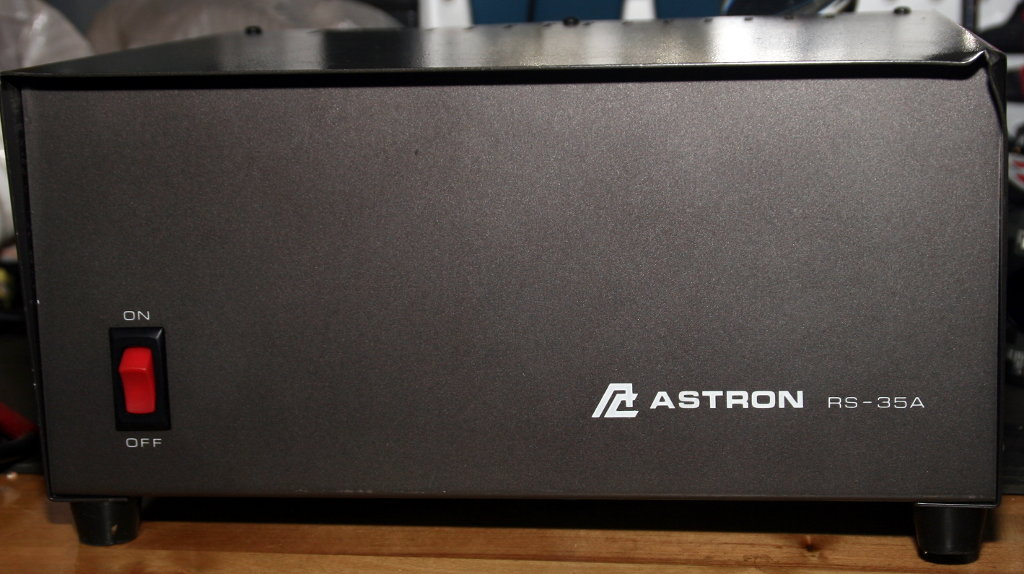
Except for a dinged up corner and a broken foot (probably during transport) it’s physically in good shape. After plugging the unit in, flipping the power switch brings the beast to life with an intimidating but satisfying “chunk” from the transformer and the hum of electricity.
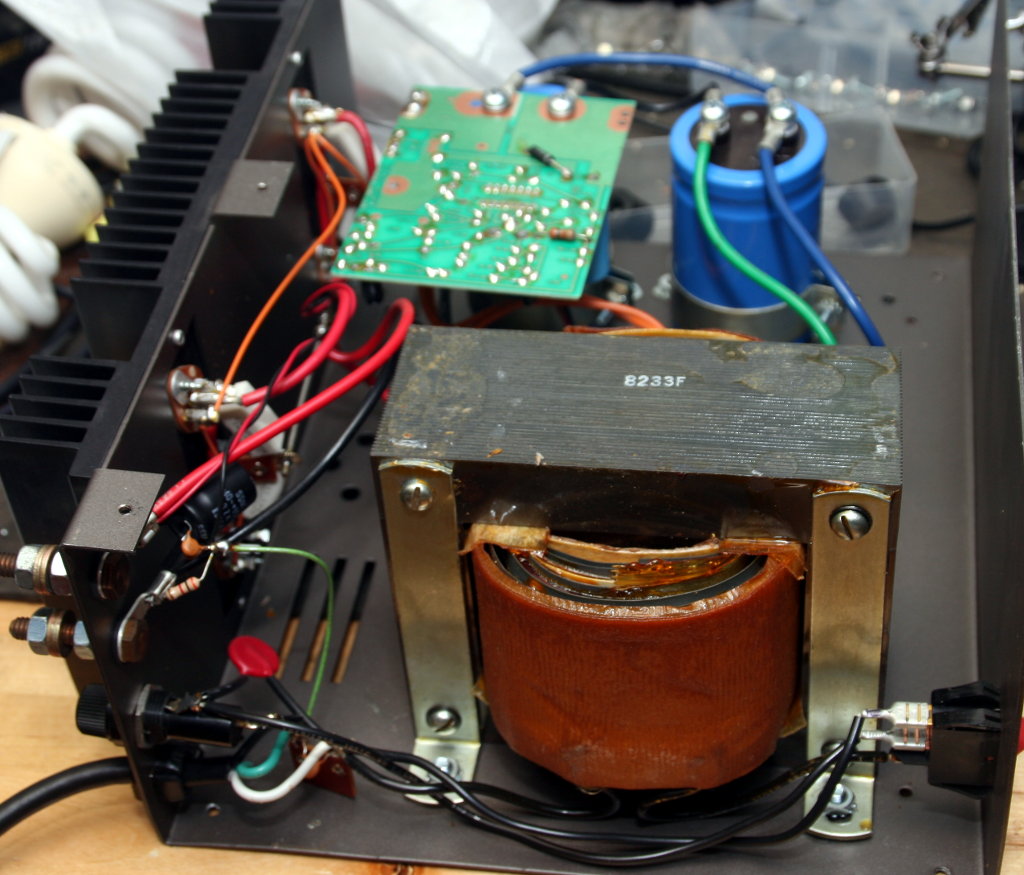
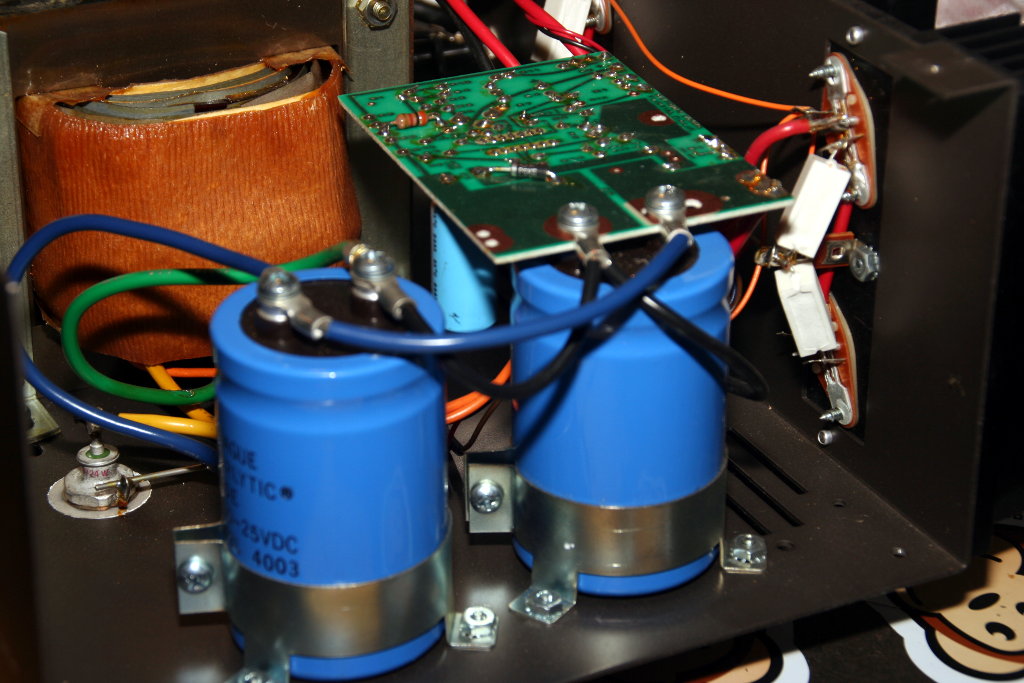
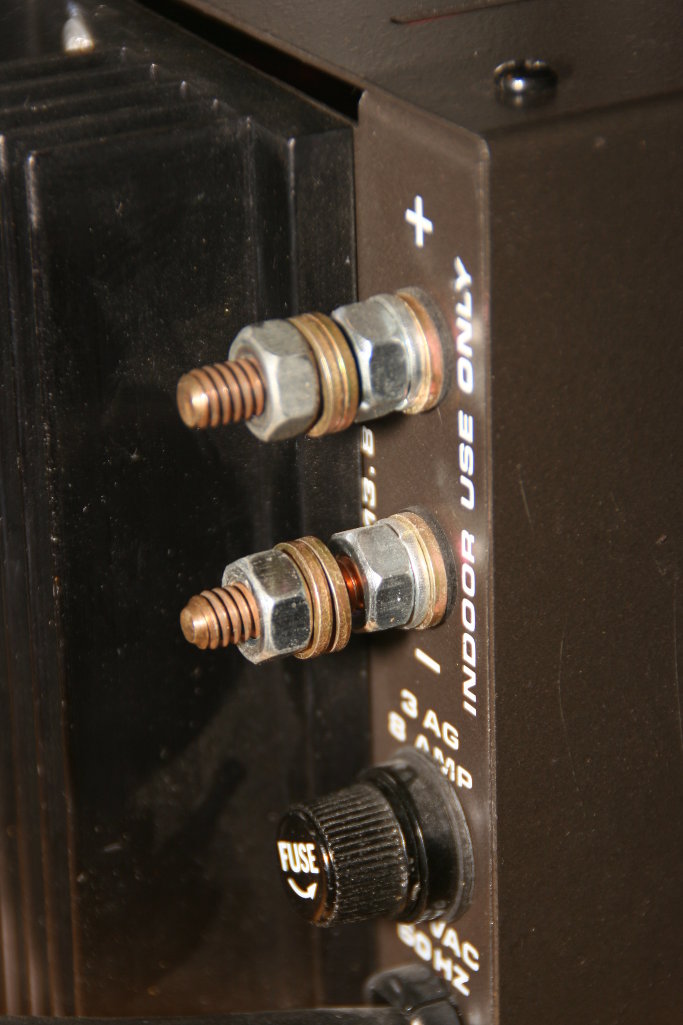
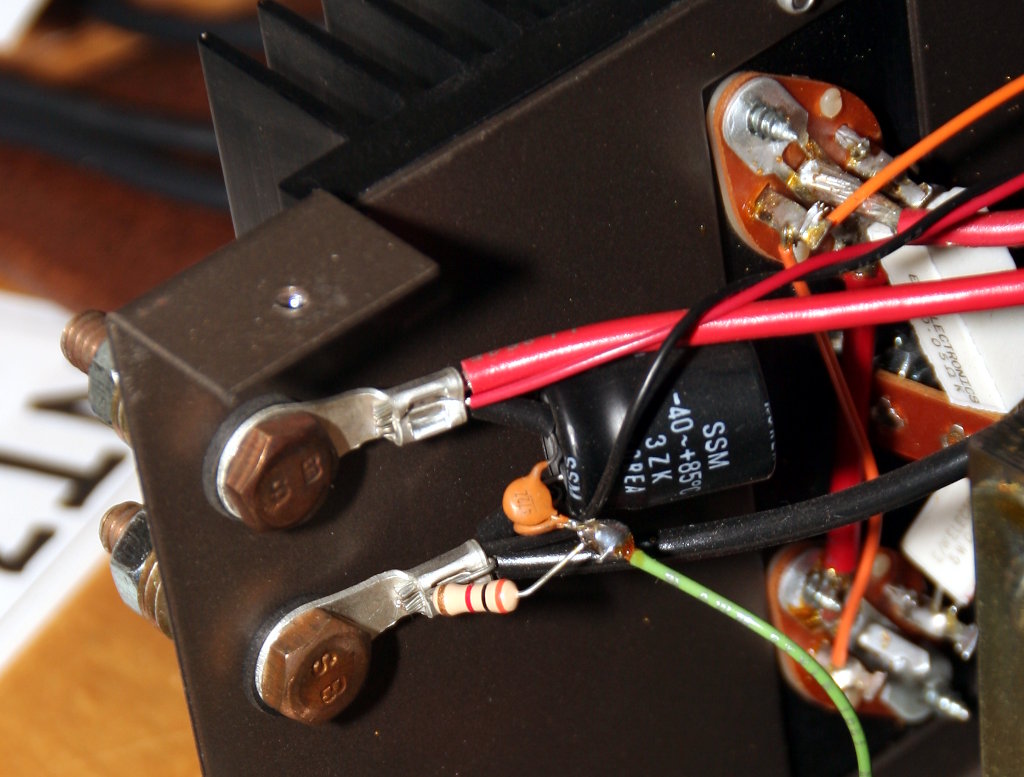
The power terminals are these bare exposed bolts with nuts to hold any wires on. I don’t really like the thought of exposed power terminals, so I think I’ll look into replacing them with some Anderson power poles.
Oscilloscope connector
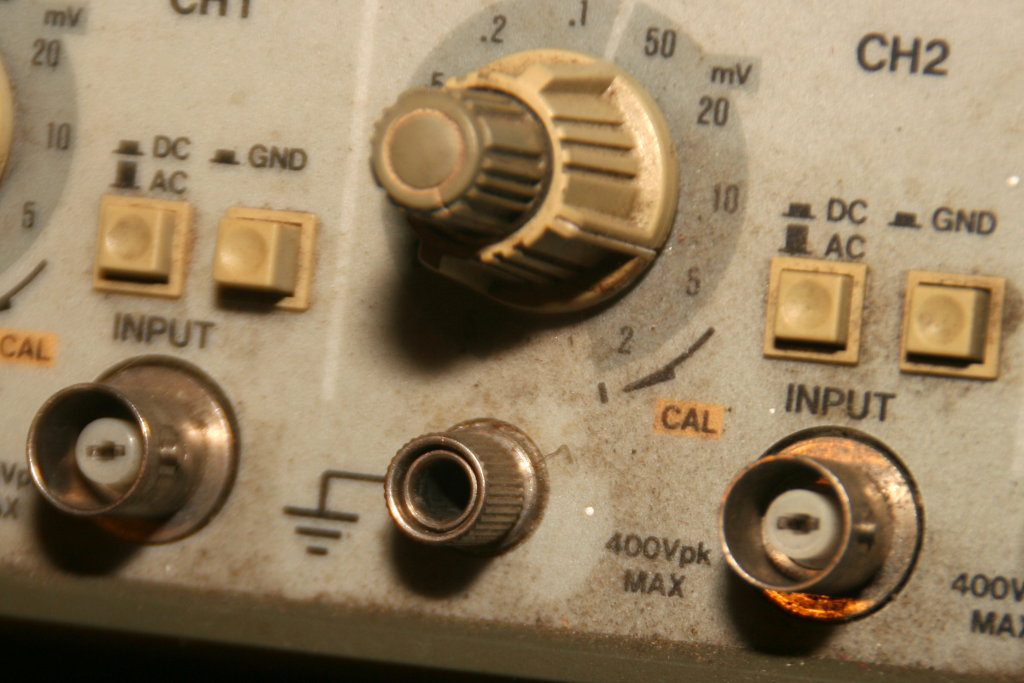
The inputs for the oscilloscope are regular BNC connectors, but the ground connector is one I’m not familiar with. It looks kind of banana plug-ish, but longer than what I’d normally expect for a banana plug.
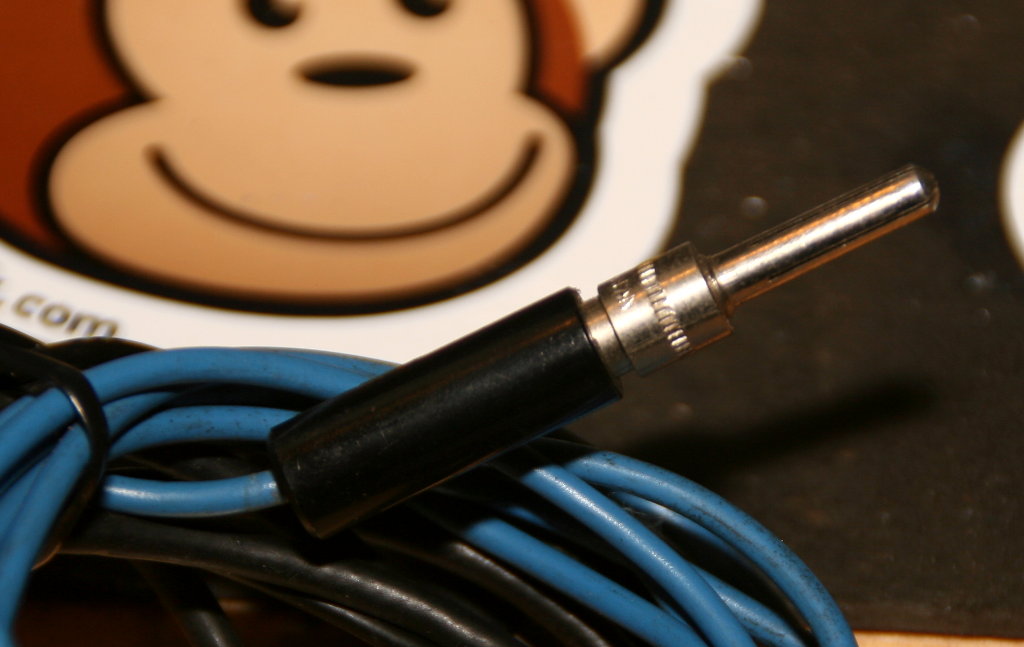
Here’s the ground connector on the scope
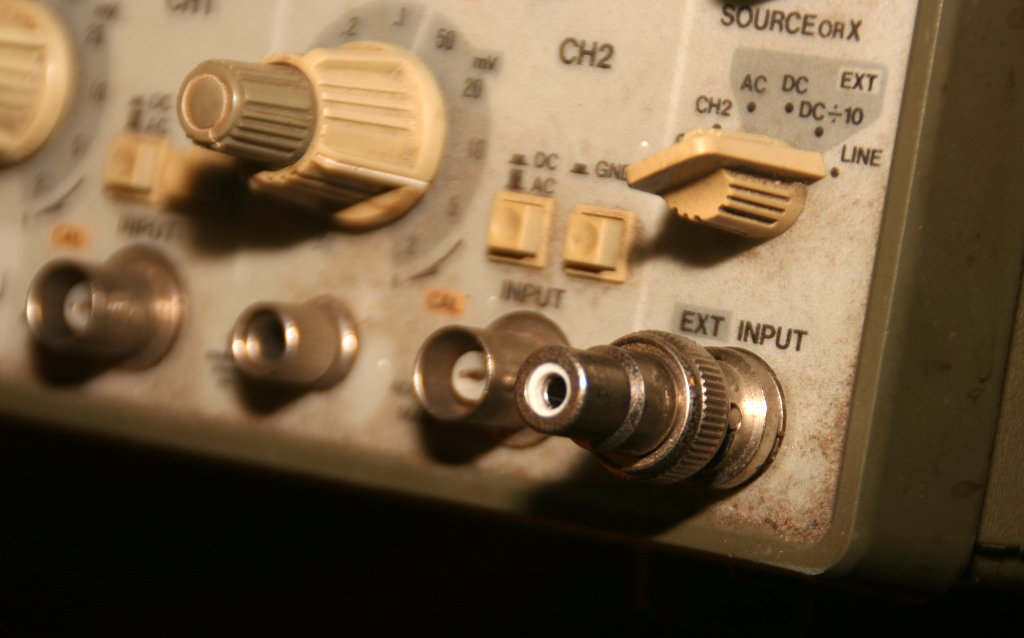
There’s also this BNC adapter for some other kind of plug. Looks kind of like a phono connector.
I was able to find a manual and service manual for the scope, which will come in handy.
Next step will be to plug it in and see how things are.
Inside the signal generator
The inside of the signal generator looks in pretty good shape, almost like it was assembled yesterday. Plugged it in, turned it on and was rewarded with a soft orange glow from the two vacuum tubes inside.
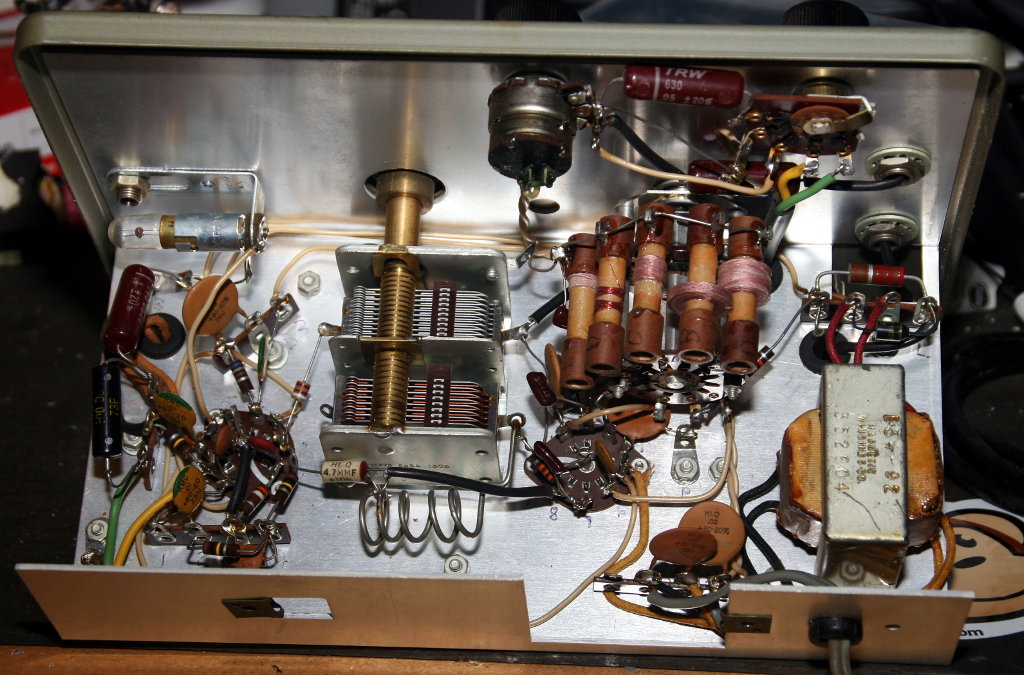
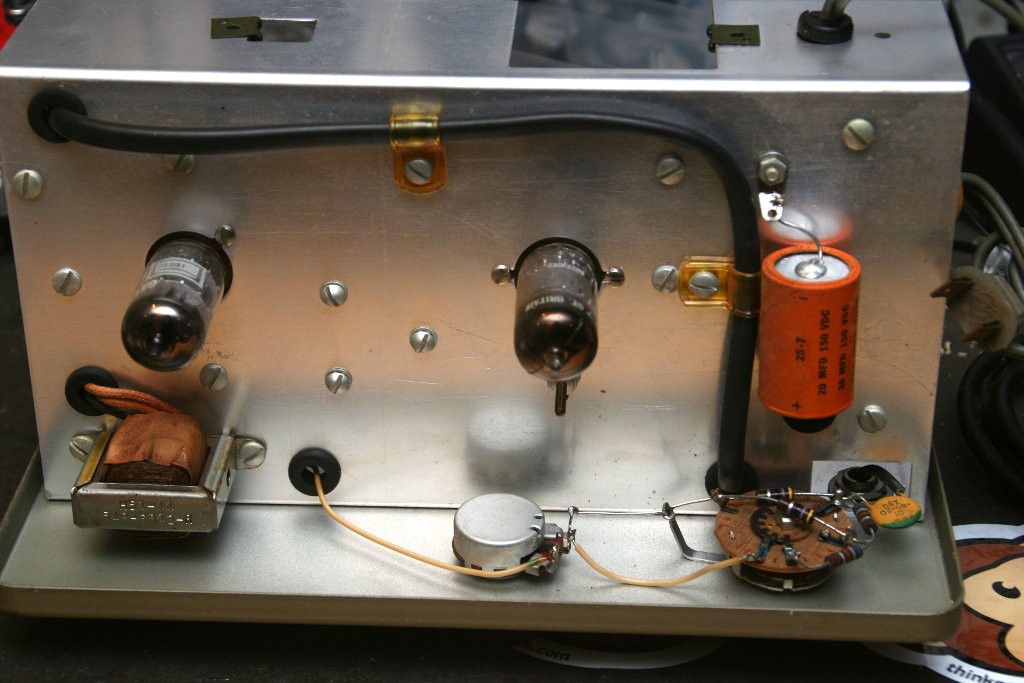
There’s one very large electrolytic cap that’s marked 20 MFD which according to the schematic appears to be a 20 μF cap. It has two positive leads going into it and I’m not entirely sure I’d be able to find an exact replacement for it. Probably need to sub in 2 20 μF caps if it does need to be replaced.

The guy at http://www.heathkit.nu/ replaced the two signal outputs on his IG-102 with BNC connectors, which seems like a pretty good idea and something I think I’ll try to do as well. Otherwise I’d probably have a hard time finding leads with the original style connectors to use. I’ll need to find some panel mount BNC connectors (female) and might need to snip/replace some capacitors to replace the old connectors.